AI will not replace physicians. It will make them sharper — and patients healthier. Organizations that understand this distinction will lead. Borealis Health Partners helps health systems and health tech founders get there. Senior counsel grounded in clinical reality, not vendor marketing.
Six expert panelists. The week's most significant developments in medical imaging AI, PACS, and healthcare technology. Vendor-neutral. Evidence-driven. No hype.
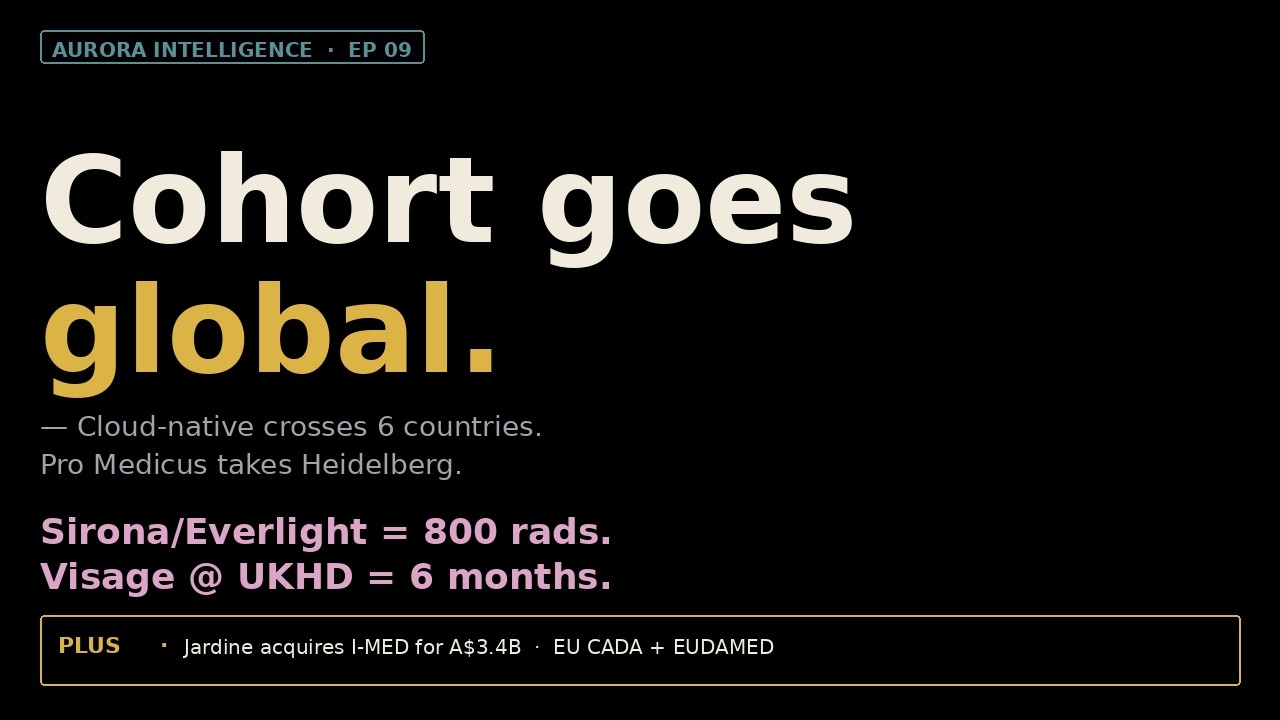
The cloud-native cohort takes its first international enterprise win. Jardine acquires I-MED for A$3.4B. Pro Medicus goes live at University Hospital Heidelberg. EU Cloud and AI Development Act published.
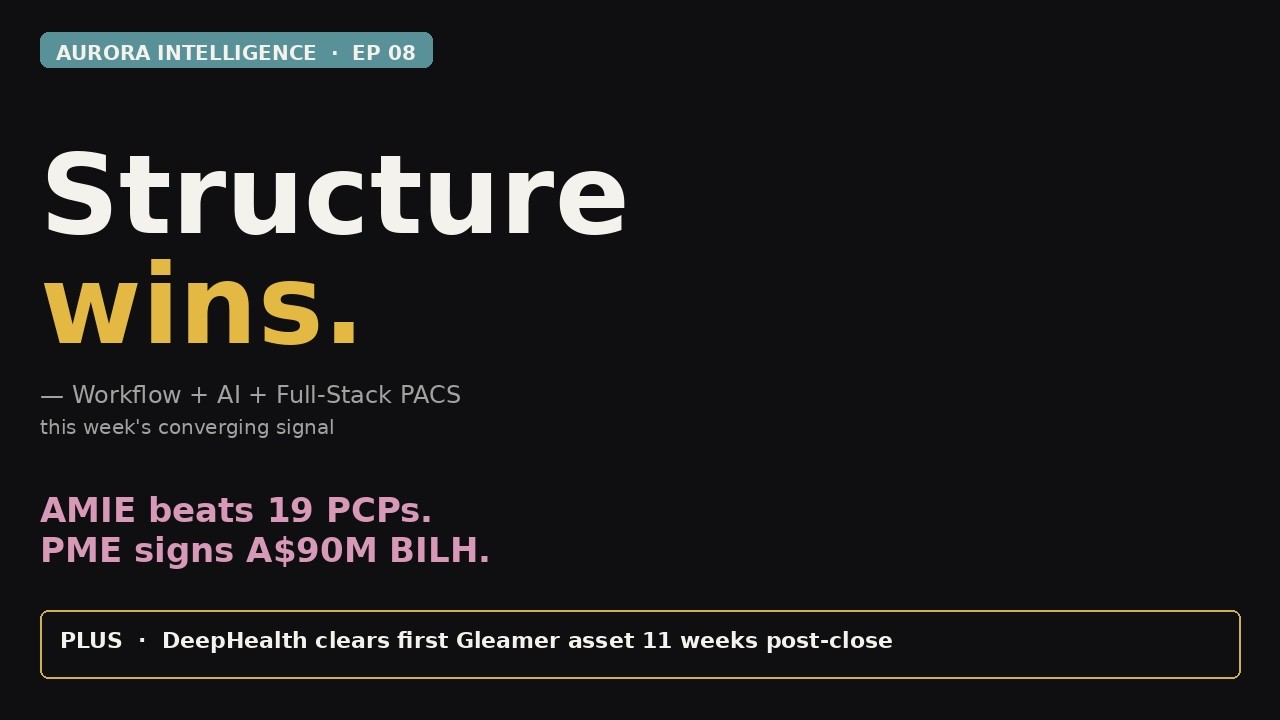
Structure Wins: AMIE vs 19 PCPs. Pro Medicus A$90M.
Eric Topol: virtually no real-world evidence for LLMs in clinical decision support. GE HealthCare completes $2.3B Intelerad acquisition. Pro Medicus goes live at University of Colorado.
Health systems, health tech startups, and investment funds — served by 29 years at the frontier of health technology, not observed from a distance.
Health System Advisory
Strategic counsel for mid-to-large health systems, regional imaging networks, and diagnostic centres navigating the transition to cloud-native PACS and AI-integrated workflows. The work is specific: vendor selection, RFP architecture, clinical change management, and building the internal case for technology investment — using health economics frameworks that procurement committees actually respect.
AI Vendor Selection Sprint — From 200+ vendors to a defensible shortlist in 3–4 weeks. Scored evaluation matrix, ranked shortlist, and recommendation memo your procurement committee can act on.
Cloud PACS Business Case — The CFO memo that makes a $10M+ migration decision defensible. Full health economics analysis (QALY, CADTH, ICER), 5-year TCO model, and board-ready presentation.
AI Readiness Assessment — A structured diagnostic across five dimensions: technical infrastructure, clinical workflow readiness, organizational change capacity, regulatory posture, and financial investment capacity. 1–2 weeks.
Strategic Retainer — Embedded Senior Counsel — A fractional Chief AI Officer for imaging. Present in leadership discussions, vendor negotiations, and board preparation. 1–2 days per week, ongoing.
Health Tech Startup Advisory
Senior product, strategy, and go-to-market partnership for early-to-growth stage companies in healthcare AI, digital health, and clinical technology. Most founders don't hit a technology wall — they hit a translation wall. Clinical evidence, regulatory reality, how health systems actually buy. That translation is the work.
Go-to-Market Architecture — Built by someone who has been the buyer. Market segmentation, buyer persona mapping (CMIO vs CFO vs radiologist — different languages, different criteria), health system sales motion design, and a 12-month commercial roadmap.
Regulatory Pathway Navigator — Health Canada SaMD. FDA 510(k). CE Mark. A roadmap, not a guess. Pre-submission strategy, clinical evidence requirements, and timeline mapped against your actual product state.
Clinical Advisory Board Formation — Physicians at the centre, always. Governance framework, clinician recruitment across target specialties, evidence generation plan aligned to regulatory pathway. Network includes mentors at Stanford and UC San Diego.
Physician-First Product Review — What a skeptical radiologist would say — before your health system meeting. Clinical workflow integration audit, evidence credibility review, and a written memo with prioritized recommendations. Delivered in one week.
Investment Fund Advisory
Advisory to venture capital, private equity, and strategic investors evaluating health tech and digital health opportunities. Fund managers need answers to hard questions: Does the clinical evidence hold up? Is the market thesis defensible? Can this team navigate health system procurement? Those questions require someone who has been inside all three for 29 years. That perspective cannot be replicated from the outside.
Health AI Due Diligence — 29 years inside the decisions, not observing from the outside. Clinical evidence review, technical architecture assessment, regulatory risk rating, GTM thesis validation, and health system procurement reality check. Delivered as a written report per deal.
Portfolio Strategic Support — Ongoing advisory to portfolio companies on commercial strategy, clinical validation, and health system sales. The advisor your portfolio companies need but cannot afford full-time.
Health AI Market Intelligence — Quarterly signal, not noise. Briefings on SaMD adoption curves, regulatory shifts (CADTH, FDA, Health Canada), competitive dynamics, and health system buying behaviour — synthesized from active client work and conference intelligence (CAR, RSNA).
Why now
The time for healthcare innovation is now.
Conditions for meaningful change in healthcare have rarely aligned like this. Not because of AI alone — but because structural pressure, collapsing technology costs, and a genuine shift in health system willingness have converged at once. This is not an opportunity to automate physicians. It is an opportunity to amplify them — and to build systems that measure outcomes that matter. Understanding this moment is the difference between leading the transition and managing its aftermath.
Adoption curve
Crossing the chasm — but not where you think
Most discussions about healthcare AI get the moment wrong. Treated as either a future promise or a current hype peak. Both are wrong.
For SaMD pixel applications — AI that reads images, flags findings, and triages studies — the market is crossing the chasm right now. Here is what that looks like on the ground:
Early adopters have proven clinical value and ROI
The early majority is beginning to move
Standards are being written — now
Vendor relationships are locking in — now
Workflow integrations are being embedded — now
This is not the peak. It is the inflection — the most consequential moment in a technology transition. Organizations that engage now will shape the standards. Those that wait will inherit them.
The window to lead is open. It will not stay open.
34%of the market is in the early majority — the largest, most valuable cohort. They are beginning to move. Right now.
The new math of AI
$30 → $0.15GPT-4 equivalent cost per million tokens, 2023 → 2025
This is moving faster than any curve in human history
AI capability and cost are not following Moore’s Law — they are moving faster, by an order of magnitude.
GPT-4 equivalent inference: $30 → $0.15 per million tokens, 2023–2025
A 200× reduction in under two years
Moore’s Law: 2× every two years. AI inference: 50× per year
Use cases cost-prohibitive in 2022 are cheap today
The ROI analysis your organization ran two years ago is wrong. Re-run it.
“AI is coming” is the wrong frame. It is already here, and compounding. The organizations adapting their workflows, data infrastructure, and clinical culture now are building an advantage that grows every quarter.
The ones waiting for certainty will not be catching up — they will be starting from zero against competitors who have been building for years. In a technology transition moving at this speed, standing still is a strategic decision with permanent consequences.
The right lens
AI enhances the physician. It does not replace them.
Most dangerous misconception in health AI: the automation framing. Physicians are not a cost to be engineered out — they are the intelligence that gives AI meaning. AI's value in healthcare is not efficiency for its own sake. It is more time with patients, sharper diagnostic tools, and earlier warnings that change outcomes. Technology that doesn't serve that goal isn't innovation. It is a distraction.
For health systems
Embrace AI as a force multiplier for your clinical teams — not a headcount reduction strategy. The systems that win will be the ones that use AI to deliver better outcomes per physician, not fewer physicians per outcome.
For innovators
Build with physicians, not around them. Clinical validation is not a checkbox — it is the work. The measure of success is outcomes that matter to patients, not adoption metrics on a dashboard.
The structural catalyst
Three converging forces that make this moment different.
Demographic Pressure
Volume ↑Specialists flat
Canada’s radiologist pipeline can’t keep up with an aging population. Imaging volumes rise. Read times stretch. No hiring wave closes a structural gap — workflow AI does.
Productivity Crisis
#Lastin OECD
Canada ranks last among OECD peers — 14 of 16 consecutive quarters of negative productivity growth. Ottawa has made this a federal priority. AI-enabled efficiency is now a budget argument, not just a clinical one.
Cost Pressure
Spend ↑Budgets flat
Per-capita spend outpaces provincial budgets. The ROI case for AI can be made rigorously — using CADTH-aligned health economics that payers recognize and approve.
The question is no longer whether to engage with healthcare AI — it is whether your organization is building the internal capacity to lead that transition or waiting to react to it.
The pattern of failure
Big tech keeps getting healthcare wrong. The pattern is consistent.
Microsoft HealthVault. Google Health — twice. IBM Watson Health. Haven. Oracle and Cerner. Six high-profile failures across two decades, each with unlimited capital and world-class engineering talent. Never a technology problem. Always the same fundamental underestimation: healthcare requires simultaneous fluency in clinical trust, regulatory complexity, and the slow, procurement-driven reality of health system sales cycles.
Organizations that succeed here understand it from the inside. That understanding is not available off the shelf.
✕
IBM Watson HealthAcquired Merge Healthcare for $1B in 2015. Sold imaging assets six years later. Underestimated clinical workflow complexity at every layer.
✕
Google Health (1.0 & 2.0)Two separate attempts, 2008–2012 and 2018–2021. ~570 staff redistributed. Division dissolved. Consumer UX thinking collided with clinical reality.
✕
Haven (Amazon · JPMorgan · Berkshire)Three of the world's most powerful organizations. Disbanded in three years. Misaligned incentives proved more durable than combined market cap.
✕
Oracle + Cerner$22B acquisition in 2022. Lost 57 hospital customers. Still exploring exit. Enterprise healthcare is not an enterprise software problem.
About
Three domains. Simultaneously. That's the rarity.
Most consultants own one domain. Occasionally two. Meaningful innovation in healthcare demands all three — simultaneously.
Clinical
Enterprise imaging across every speciality
Radiology · Pathology · Cardiology · Orthopaedics · Oncology — the full enterprise imaging spectrum
Stanford Medicine · Mayo Clinic · Northwestern · Santé Québec · $693M PACS · 70+ countries
Stanford Medicine · Mayo Clinic · Northwestern · Harvard VBHC · Queen's MBA
29 years at the intersection of all three. A vantage point that cannot be hired, assembled from parts, or replicated. Not a technologist selling AI. Not a consultant who has observed healthcare from the outside. Someone who has spent three decades inside clinical, technology, and business reality simultaneously — and believes, fundamentally, that the purpose of all of it is better outcomes for patients. Recognized as a thought leader by CIFAR and the Canadian Association of Radiologists, advising both on the state of AI in diagnostic imaging and health system adoption strategy. The clinical network built across three decades — including a lasting mentorship with Michael C. Muelly, M.D. (Clinical Assistant Professor of Radiology, Stanford; Co-founder & CTO, IMVARIA) — reflects a career spent inside clinical reality, not observing it from the outside.
UoWWorld-class math, CS & engineering talent density
2023 — Present
Director, Innovation & Strategy
Sectra
Santé QuébecWorld’s largest provincial PACSMicrosoft AzureAI clinical innovation
Leading AI strategy and innovation at one of the world’s most trusted medical imaging companies — a global leader in enterprise imaging across radiology, pathology, and orthopaedics.
Built the AI commercial pipeline from the ground up — growing active AI opportunities from a single engagement to dozens across the global customer base. Translated emerging AI capabilities into clinical strategy and commercial traction at enterprise scale.
Instrumental in winning Sectra’s largest customer to date: Santé Québec — a province-wide enterprise PACS deployment covering the entire Quebec health system on Microsoft Azure. A scale of enterprise imaging not seen anywhere in the world. Working directly with SQ physicians on strategic AI research and clinical innovation for AI adoption at provincial scale.
Took ownership of customer success — including relationships requiring active turnaround. Rebuilt trust and deepened executive engagement with health systems that demanded senior, experienced leadership to navigate complex, high-stakes deployments.
Led advanced deployment initiatives that required deep product and clinical collaboration — complex go-lives and technical integrations that pushed beyond the standard playbook, drawing on extensive prior experience to guide teams and customers through challenges with no precedent in the local market.
Recognized as a thought leader by CIFAR and the Canadian Association of Radiologists — advising both organizations on the state of AI in diagnostic imaging and proposing adoption strategy for health systems at scale.
Led Sectra's first clinical AI deployment at William Osler Health System — pitching the application strategy directly to executive and clinical leadership, earning credibility by speaking the language of every stakeholder in the room simultaneously: clinical outcomes, technical risk, and executive ROI. Where a comparable Ontario health system's previous AI deployment took 3 years, the full deployment cycle at William Osler — from workflow design through retrospective quality check, shadow mode, and live clinical use — was completed in 6 weeks. The difference was preparation: aligning executive, radiology, and ED leadership before a single line of code was deployed.
2020 — 2022
Senior Director, Product
Arterys (acq. by Tempus)
First commercial pixel AI SaMDCardiac → MSK → Neuro → Onco3× market expansionCloud-native decadeMichael C. Muelly, M.D. · Stanford Radiology · IMVARIA CTOAlbert Hsiao, MD, PhD · UC San Diego · Cardiovascular AI
A deliberate step into Silicon Valley-style company building — venture-backed, founder-led, moving at a speed that enterprise healthcare rarely tolerates. The discipline of startup velocity, under simultaneous investor and clinical customer scrutiny, is a different discipline from enterprise leadership — one that directly informs how Borealis Health advises founders navigating the same pressures.
Arterys launched the world's first FDA-cleared, pixel-level AI Software as a Medical Device (SaMD) — a watershed regulatory milestone for an entire category (2018). A decade of cloud-native architecture before most vendors had even started the conversation.
Tripled the addressable market through strategic repositioning. Deepened enterprise relationships with leading academic medical centres and health systems across the United States, Canada, and internationally.
Led expansion of the clinical AI suite from cardiac into MSK, Neuro, and Oncology — not by volume, but by curation. Assembled a clinical advisory board to identify and select the highest-value algorithms across four imaging specialties. From that field, a focused cohort was selected for deep integration into actual physician workflow — full brain evaluation, multi-model selection, integrated to MVP across all four specialties faster than anyone in the market had done. The result was not a catalogue of AI tools. It was a coherent clinical AI architecture that remains, to this day, the clearest working example of what the future of diagnostic imaging looks like — and that underlying technology stack continues to be leveraged in healthcare in new forms.
Partnered with clinical, engineering, and regulatory teams to translate complex AI model outputs into explainable, workflow-embedded clinical tools — setting a product standard that shaped subsequent FDA submissions across the industry.
Co-designed cutting-edge AI UX with University of California San Diego — led by Albert Hsiao, MD, PhD, one of the most intellectually rigorous people in the field. Dr. Hsiao taught a deeper understanding of cardiac MRI and the clinical reasoning that AI must earn the right to augment. Working at the research-to-production frontier on how radiologists actually interact with AI outputs in a live clinical workflow, the collaboration shaped how Arterys approached explainability, interface design, and radiologist trust — design principles that remain central to how Borealis Health advises health tech founders building clinical AI today.
Built a lasting clinical mentorship with Michael C. Muelly, M.D. — Clinical Assistant Professor of Radiology at Stanford University, Co-founder & CTO of IMVARIA, and former Google AI Research (Healthcare). The relationship forged at Arterys represents the kind of deep mutual respect that only develops when product and clinical reality are built together from the ground up. Dr. Muelly continues as a trusted mentor and clinical sounding board for Borealis Health.
2018 — 2020
Senior Solution Manager, Enterprise Imaging
Change Healthcare
Stratus on Google CloudNucleus.io acquisition60-practice studyData-first philosophy
Led the strategic shift from departmental PACS to enterprise health system strategy — reorienting product narrative, sales motion, and executive relationships toward the C-suite.
Founded and built Stratus — a cloud-native enterprise imaging platform on Google Cloud, one of the earliest production-grade cloud PACS platforms in the North American market. Influenced architecture and direction from the ground up.
Ran a simultaneous build-or-buy exercise for zero-footprint viewer technology — two independent internal development teams competed against each other in parallel while an external market diligence process evaluated commercial alternatives. The internal competition created urgency and a real benchmark. The market diligence narrowed the field to two high-conviction contenders: Arterys and Nucleus.io. Change Healthcare ultimately acquired Nucleus.io — a decision informed by rigorous internal and external evaluation running concurrently. This is the kind of structured competitive pressure that produces better decisions faster.
Executed a 60-practice clinical study across 30 IDNs and 30 independent practices — the definitive clinical evidence and go-to-market foundation, and where the operating principle of trusting data over assumption was forged.
Represented the company directly with health system leadership across the US: rebuilding trust and leading onsite commercial teams through strategic tender processes.
2002 — 2018
Product & Marketing Leadership
Agfa HealthCare
€170M turnaround200-person R&D$693M IMPAX platformStanford · Mayo · Northwestern
Rose from Product Manager to Senior Global Marketing Manager over 16 years, managing IMPAX — a $693M revenue PACS platform — across 70+ countries. Led R&D groups as large as 200 people.
Led product for much of IMPAX 6 — one of the most widely deployed enterprise radiology platforms in the world. Then led product and marketing strategy for Enterprise Imaging from cradle through US launch — two of health IT's most significant platforms, built and taken to market from the inside.
Executed one of health IT's most significant product turnarounds: stepped in after a year of failed leadership, a programme 12 months over schedule with €170M in missed revenues. Delivered the release. Rebuilt go-to-market strategy, competitive positioning, and global marketing execution across EMEA, North America, and APAC.
Won marquee accounts including Stanford Medicine, UMass Medical System, London Health Sciences Centre, and Northwestern Medicine — validating clinical credibility at the highest levels of academic medicine.
Thousands of hours invested alongside physicians across specialties — understanding clinical workflow at the level of individual keystrokes and cognitive load. The clinical proximity accumulated here is the foundation that makes every subsequent role possible.
1997 — 2002
Integration Specialist & Project Manager
Mitra Imaging (acq. by Agfa HealthCare)
Eric Peterson C.M.First HL7/DICOM integrationsEuropean ops — EindhovenMcMaster clinical co-op
First role in health tech — emerging from Silicon North, the Waterloo region's golden era of technology innovation. Waterloo's position as a global tech hub is not accidental: the University of Waterloo brings together one of the world's largest concentrations of math, computer science, and engineering talent, and channels it into industry through a co-op network spanning 8,000+ employers in 70+ countries. The region consistently ranks as #1 small tech talent market in North America. Mitra Imaging was ground zero for radiology's shift from film to digital — and a direct product of that talent engine.
Grew up professionally under Eric L. Peterson (C.M., Order of Canada) — an environment that was intellectually rigorous, mission-driven, and world-class. It remains the single most formative chapter of the career.
Hands-on UX training with Alan Cooper — the Father of Visual Basic and author of The Inmates Are Running the Asylum — as part of the team designing the future of digital radiology. Cooper trained the team on his methodology, we applied it, he critiqued it, and we iterated — the full design engagement cycle. Silicon Valley thinking, Northern execution. Cooper's central argument: technologists build products for themselves, not users. That lesson has shaped every product and UX decision since.
Early team that revolutionized healthcare imaging interoperability. Built foundational fluency in HL7, DICOM, and HIS-to-modality integration from 1997 — experience that now spans 29 years of continuous innovation in the space.
Relocated to Eindhoven, Netherlands to build and lead Mitra's European operations from the ground up — selling, deploying, and regionalizing products and services across European markets. Recruited the first European technical team, who went on to long successful careers through the Agfa acquisition. An orientation that has defined every role since: building for the world, not just the market where you happen to sit.
MBAQueen's University
Value-Based HealthcareHarvard Business School
Applied Generative AIMIT Professional Education
Executive EducationStockholm School of Economics
Investment Fund AdvisoryVC · PE · Strategic · Ongoing
Get in touch
Ready to build something important?
Whether you're a health system evaluating your next imaging platform, a CMIO building the case for AI investment, or a founder navigating the gap between clinical validation and commercial traction — let's find out if we're a fit. All conversations are confidential.